He is the favorite enemy of Hungarian prime-minister Orbán, Turkish president Erdogan, and Russian president Putin. Internet trolls depict George Soros as the Jewish capitalist who wants to throw the borders open, mix the races, and flood the West with Muslim refugees. The conspiracy theory that Soros was funding the migrant caravan that is making its way to the U.S. was taken up by Donald Trump and Fox News, which seems to have made the demonizing of Soros its top revenue model. In The Netherlands, he was attacked because of his support for a referendum on the EU-Ukraine Association. Dutch daily newspaper De Telegraaf portrayed him as the hidden funder behind the Kick Out Zwarte Piet action group. Zwarte Piet, or Black Pete, is the helper of St. Nicholas and part of a traditional holiday festival. Because Black Pete is usually played by a white person in blackface, the character has become controversial.
If 2018 was the year of the revival of the autocratic leader, then George Soros became the symbol for the defense of the open, democratic society. It is not for nothing that Putin, Orban, as well as Erdogan, have ousted Soros’s Open Society Foundations (OSF) from their countries. And if this year was also the year of revived anti-Semitism, then George Soros was the personification of the satanic Jew. He was permanently under fire from alt-righters, even literally, when a pipe bomb was found in the mailbox of his house near New York, allegedly mailed by Trump-adherent Cesar Sayoc, who was obsessed with George Soros.
Fifteen billion dollars
Who is George Soros, object of hate by authoritarian world leaders and conspiracy theorists? What is the mission of the Open Society Foundations? And how do Soros and his staff defend themselves against the endless flood of accusations and attacks?
Eighteen hundred Soros/OSF staff members annually spend a billion dollars on projects and people that are dedicated to work for a tolerant, free society. In total until now, the Soros foundations have spent fifteen billion dollars in support of this cause in thirty-five countries.
We talked to people who know Soros and who are or were active in OSF, from Patrick Gaspard, former ambassador during the Obama-administration and since last year president of the Open Society Foundations to Princess Mabel of Orange, who worked for the organization for years. From Goran Buldiosky, director of OSF’s European headquarters in Berlin, to Michael Ignatieff, the Canadian president and rector of the Central European University, founded by Soros.
Selfish and selfcentered
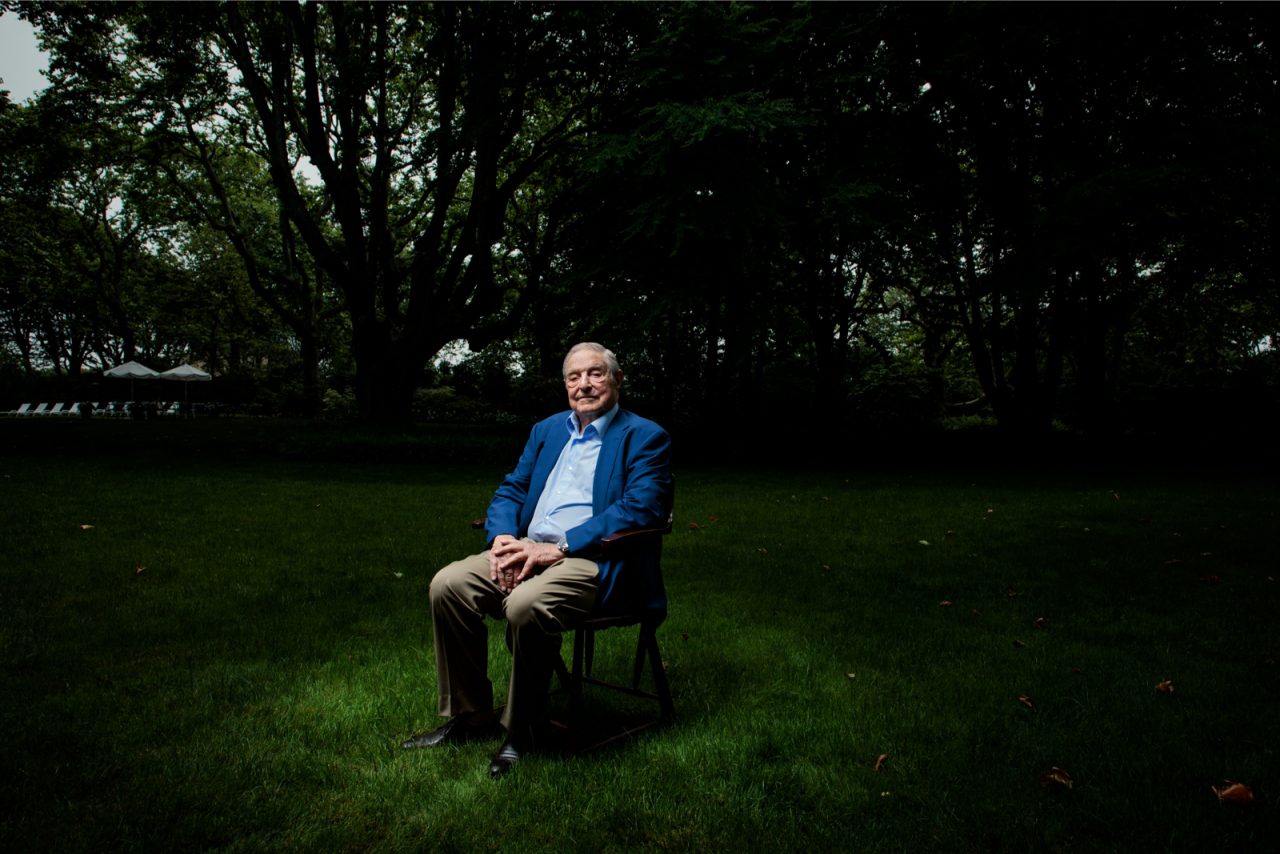
Businessman George Soros (88) made his fortune as a hedge fund owner and financial trader. In 1992, he made a billion dollars in profit during the UK currency crisis, a day which became known as Black Wednesday. On the Forbes’ list of the world’s billionaires, Soros dropped to 170th place last year, because he gave $18 billion that year to OSF. His estimated wealth is 8.3 billion dollars. Jeff Bezos, founder of Amazon, is worth fifteen times that.
‘It is not so strange, when you survive the Holocaust and have witnessed communism win, that you are deeply interested in the question how a liberal society can resist totalitarianism,’
While other supremely wealthy individuals put their money in soccer clubs, art collections, or media companies, Soros decided – after he developed heart problems from the stress of trading in the financial markets – that he wanted to use his fortune to better the world. Because of his upbringing – his father spoke the international language Esperanto – he refuses to be limited by borders and likes to involve himself in what seem to be unsolvable problems, as he wrote in My Philanthropy, one of the fourteen books he has published. In that book, he is quite critical of philanthropy. ‘I am both selfish and self-centered and I have no qualms about acknowledging ……[that] philanthropists are primarily concerned with their own benefit.’
The art of survival
The source of his philanthropy is clear, and is emphasized by Soros: as a Jewish boy in Hungary he escaped the Holocaust thanks to his father, Tivadar Soros, a lawyer who provided false identity papers to his family, friends, and many others. As a young teenager, Soros lived in fear during the Nazi-occupation, but this was also a time full of suspense and sometimes even happiness. He admired his daring father, who protected the family against a murderous force. ‘I learned the art of survival from a grand master,’ wrote Soros in his introduction to Masquerade, the book his father wrote in Esperanto about the Nazi occupation of Budapest. ‘All of us have an obligation to help the helpless when their human rights are violated and when atrocities are perpetrated against them,’ wrote Tivadar – and son George listened to him closely.

After the war it became clear that half a million Hungarian Jews had been murdered by the Nazis and their local collaborators, the Arrow Cross Party. George lived briefly in communist Hungary, until he was able, again thanks to his father, to travel to England. He studied philosophy at the London School of Economics, where philosopher Karl Popper taught and whose ideas about the open society would inspire Soros for the rest of his life.
Interested in back talk
‘It is not so strange, when you survive the Holocaust and have witnessed communism win, that you are deeply interested in the question how a liberal society can resist totalitarianism,’ says Yoeri Albrecht, director of De Balie, a center for politics, culture, and media in Amsterdam. Albrecht is also a former editor of Dutch magazine Vrij Nederland and chairman of the advisory council for the Open Society Initiative for Europe. ‘Let’s be clear, there are mechanisms in society which can lead in the worst case to what Germans call Gewaltherrschaft: a government which exerts violence on its own citizens.’
Albrecht got to know George Soros when he and others were invited by Soros for a breakfast meeting in Vienna to exchange ideas about the future of Europe. Albrecht says he got to know ‘a very special man,’ who worries about the future of democracy in Europe and who is open to criticism. ‘Soros will never claim that he has all the answers, he is always interested in counter-arguments,’ says Albrecht. ‘In that he follows philosopher Karl Popper’s thinking, in which fundamental doubt plays a role.’ But ultimately, he doesn’t want to be judged on his words, but on his actions, says Albrecht. ‘Soros is the “practice what you preach” type.’
Intangibles
While others erect statues or museums to live on in history, Soros has invested his fortune in humane social initiatives since 1984, when he set up his first foundation in communist Hungary. ‘He has supported NGOs and citizen initiatives with billions of dollars, says Daniel Sachs, CEO of the Swedish investment company Proventus AB. ‘The rule of law and democracy has been close to his heart.’
Sachs, himself a well-known philanthropist and founder of Apolitical Academy – a training school for the next generation of public leaders – got to know George Soros in 2006 when Soros was helping to establish the European Council on Foreign Relations. ‘I was invited as one of the fifty members of that council,’ said Sachs. A focus of the Council was the rise of populism in Europe, reaching even into Sweden. Later Sachs joined the Global Board, the Board of Directors of the Open Society Foundations (OSF), of which Soros himself and his children Jonathan, Alexander, and Andrea are members. ‘George has always been an impatient man and is even more so now that he is 88,’ says Sachs. ‘As fundamental human rights are in danger, it is his mission, óur mission, to mobilize counter forces and support civil society, hold governments accountable, protect individual freedom, and fight for social justice.’
‘When you oppose George Soros and OSF, you question the values of the open society.’
Having grown up in Hungary, Soros’s philanthropy has always paid special attention to Eastern Europe, in particular the Balkan countries. Of the roughly one billion dollars a year in funding that OSF divides yearly to projects all over the world, 81.7 million goes to projects in Europe and, of that, fourteen million to the Western Balkan countries.
Mabel of Orange, widow of Prince Friso and sister-in-law of King Willem-Alexander of the Netherlands, met George Soros for the first time in 1993 when, as the director and founder of the European Action Council for Peace in the Balkans, she was providing assistance to victims of the war in Yugoslavia. Later she worked for over ten years for OSF as director in London and Brussels, after which she became a member of the Global Board. ‘When you oppose George Soros and OSF, you question the values of the open society: freedom, transparency, democracy, and justice,’ she says about criticism of Soros. ‘That frightens me, because I want to live in a world where leaders do not have unbridled power, where politicians are held accountable for their actions, where freedom of expression is the norm. Exactly the issues which the Open Society Foundations support.’
Forced exile
Free debate and parliamentary accountability is under threat in Hungary. Victor Orbán, who as a young man received a scholarship from Soros to study political science at Oxford, does not tolerate opposing opinions. The nationalistic, authoritarian prime minister saw the Hungarian-American philanthropist as the ideal scapegoat, a bogeyman he could attack during the elections to his own advantage. So last year Orbán went on an anti-Soros rampage which was sometimes indirectly anti-Semitic and at other times openly so. Soros was accused of being directly responsible for migrants entering Hungary. Last year billboards appeared in the city picturing a laughing George Soros and the text ‘Don’t let Soros have the last laugh’.
This spring the leadership of OSF decided that staying in Budapest would be too dangerous.
In a rare statement, George Soros said that he was ‘distressed by the current Hungarian regime’s use of anti-Semitic imagery as part of its deliberate disinformation campaign.’ During the election campaign this spring, Orbán went a step further when he introduced the Stop-Soros law, which was in fact meant to expel the Open Society Foundation from the country. In the streets and in the Hungarian press, which has come increasingly under government control, photoshopped images appeared of Soros as a puppet master pulling strings, a classic anti-Semitic trope of a Jew as a master manipulator. This spring the leadership of OSF decided that staying in Budapest would be too dangerous. Staff members were intimidated by government media, their safety was at stake, and the organization moved to Berlin, in a self-imposed but, in fact, forced exile.
Hungarian storms
Since this summer, the nineteenth floor of a nameless office building near the Potsdamer Platz in Berlin is the new headquarters of the OSF team that left Budapest. Not all the 170 staff members – sixty percent of whom are Hungarian citizens, the rest coming from other countries – made the move to the German capital. Some of the Hungarian team members stayed in Budapest and a smaller office was opened in Vienna for those who were not sure about immigrating to Germany or who, because of their left-behind families, wanted to work closer to home.
‘Don’t mind the palms, they are part of the interior design,’ says the press spokesperson when we arrive. ‘These quarters are temporary and too small, we are looking for a permanent office space, but that is not so easy in booming Berlin.’
We are received in a claustrophobic glass cubicle by Goran Buldioski, the Macedonian director of the Open Society Initiative for Europe who has experienced the Hungarian storms these last few years. ‘We left with a heavy heart after we asked ourselves: can we do our work in Budapest with integrity, can we guarantee the safety of our staff in Hungary? Is this a country that gives the civil society room to breathe instead of smothering debate? Unfortunately, the answer to those questions was: “No, no, and no again.” It is becoming hard to imagine that Hungary is still an EU-country.’
It is crazy how a right wing conspiracy theory can penetrate main stream media until it is finally converted into an actual law.
It is much easier to call Soros’s motives into question, says Buldioski, than to attack an organization ‘which defends democratic checks and balances and the rights of minorities in countries like Hungary, Russia, and Turkey.’
The first signs that the Hungarian government were targeting Soros appeared in the dramatic summer of 2015 when thousands of refugees in leaky boats washed ashore on Greek islands. The pro-government Hungarian media spread the rumor that George Soros had financed the distribution of a leaflet on the island of Lesbos which showed refugees the route to Europe.
‘At first none of us took this seriously, we didn’t realize at all that this kind of nonsense could take off,’ says Daniel Makonnen, the French spokesperson for OSF in Berlin. ‘But only a few months later this fake news had become the official government position. It is crazy how a right wing conspiracy theory can penetrate main stream media, then cynically is used as fodder in the political discourse until it is finally converted into an actual law, aimed against OSF, because of which we are forced to leave Budapest. ‘
The anti-Soros rhetoric became increasingly aggressive and anti-Semitic, tells Goran Buldioski. An all time low, according to him, was a photo which Janos Pocs, a member of parlement of Orbán’s party Fidesz, shared on social media in December 2017. It depicts a group of people next to a barbecued pig. On the charred skin, the words ‘O volt a Soros’ are readable. That text in Hungarian has a double meaning: ‘This was Soros’ and ‘It was his turn.’ When the Fidesz politician posted the photo on Facebook, he wrote: ‘One pig less. Bon appetit.’ Of course, he denied that he meant George Soros. ‘This is part of a long and dark tradition of anti-Semitic imagery dating back to the Middle Ages,’ was the reaction of the Open Society Foundations. ‘It shows that in Hungary under Viktor Orbán anti-semitism is officially permitted.’
Smoke screen
In addition the American news organization Politico revealed that Israeli private intelligence firm Black Cube was involved in a smear campaign against Soros. Black Cube had earlier gathered information about the women who had accused media tycoon Harvey Weinstein of sexual abuse. Agents of Black Cube approached staff members and sympathizers of OSF in Europe and the U.S. under the false pretense of being journalists. Quotes from these so-called interviews appeared during the election campaign in Hungarian news media sympathetic to Orbán. One of those interviewed had said that about 2,000 people work for OSF, which in the Hungarian media was distorted in ‘2,000 mercenaries of Soros want to bring down Orbán, dismantle the border fence, and promote immigration to Hungary.’
‘These were crazy statements,’ says Goran Buldioski. ‘We immediately rebutted them. We don’t have two thousand staff members in Hungary, we have eighteen hundred people worldwide.’
It didn’t seem to matter: Orbán used the quote about the ‘two thousand mercenaries’ – in the right wing rhetoric the words ‘mercenaries’ or ‘soldiers’ of Soros is always used – in his campaign speeches. ‘Soros’s people want to take over the banks and the energy sector and the Hungarian people will pay the price,’ Orbán claimed. Goran Buldioski: ‘Those attacks were meant to win the elections but also to create a smoke screen behind which Orbán and his party could dismantle what was left in Hungary of independent organizations and media.’
Existential crisis
‘Everything that could go wrong has gone wrong,’ George Soros said this June to a reporter from The Washington Post in a Zurich hotel. Not only had Orbán gained an absolute majority, but earlier, Hillary Clinton, whose presidential campaign Soros had supported, had lost her election. Brexit and rising anti-immigrant sentiment in Europe meant that Soros’s plans to phase out his philanthropic work in Europe were put on hold. But he showed himself ready for the fight: ‘The bigger the danger, the bigger the threat, the more I feel engaged to confront it.’
A month later, in an interview with The New York Times, Soros sounded more pessimistic. Europe, Soros said, faced an existential crisis. ‘I’m standing for my principles whether I win or lose,’ said Soros. ‘But unfortunately I’m losing too much in too many places right now.’ The man who had declared earlier that he was proud to count Putin, Erdogan, Trump, and Orbán as his enemies, now sighed: ‘I’m not happy to have that many enemies – I wish that I had more friends.’
‘He draws a line with the grotesque allegations that he supposedly was a Nazi during the occupation of Hungary. That is just too painful.’
‘Knowing George, he said that to The New York Times with a twinkle in his eye,’ says Laura Silber. ‘That journalist didn’t see the irony. George is not somebody who feels beaten by his opponents or abandoned by his friends.’
Silber, a former journalist and co-author of the book Death of Yugoslavia, is the spokesperson at the headquarters of the Open Society Foundations in New York. ‘I stopped being a journalist because I wanted to write from a conviction, from an idea about society,’ she said. George Soros does not put his energy in objecting to the continuous stream of accusations, she maintains. ‘But he draws a line with the grotesque allegations that he supposedly was a Nazi during the occupation of Hungary. That is just too painful, not only for Soros himself, but for everybody who suffered under the Nazis. To accuse the victim of collaboration is revolting.’
Twenty years ago in an American television interview, Soros told the story of how, during the occupation of Budapest by the Nazis, his ‘father in hiding’, a Hungarian official who was protecting him from deportation once took him along as he was taking inventory at the home of a Jewish family who had fled. Their possessions would later be seized by the Nazi authorities. Soros, fourteen years old, was only an observer and did not feel guilty about it, he said in the interview.
‘So then when people, like actress Roseanne Baer, make statements, he reacts very strongly,’ says Laura Silber. In a tweet directed to Chelsea Clinton and re-tweeted by Trump, Barr had alleged that George Soros ‘is a Nazi who turned in his fellow Jews 2 be murdered in German concentration camps & stole their wealth.’ Barr later apologized.
‘Members of our staff are threatened, people who work for organizations that we support are detained, and there was a bomb at George’s home.’
‘These times demand that we push back,’ says Patrick Gaspard, president of OSF. ‘The Hungarian government has vilified our work, using methods not seen before in the European Union. Until recently these type of attacks were confined to the far on-line fringes of the political discourse. But because of the rise of authoritarian regimes in Hungary, Italy, the U.S., Brazil and in other places, they have become more and more mainstream.’
And, emphasizes Gaspard, those type of attacks have consequences. ‘Members of our staff are threatened, people who work for organizations that we support are detained, and there was a bomb at George’s home. So we have to take measures to support our founder, the organizations that we support and to defend the political middle ground in general. And with that values like justice, equality and human rights.’
Surreal
The Netherlands saw its first anti-Soros wave in April 2016 during the advisory referendum about the proposed Association Agreement between the European Union and Ukraine. The Dutch proponents of the agreement, the foundation Stem voor Nederland (Vote for the Netherlands), had received some funding from Soros’s OSF. Michiel van Hulten was one of the founders of the ‘yes’-camp. Van Hulten had been chairman of the Dutch Labour Party (PvdA) and had a long history in Brussels, where he worked for VoteWatch, an organization which follows the voting in the European parliament and the Council of ministers and analyses data. For VoteWatch, Van Hulten attended a meeting in the U.S. with George Soros to discuss the European elections.
‘That meeting in Soros’s home in the Hamptons was a special experience,’ says Van Hulten. ‘I was impressed that Soros showed himself to be so engaged with European politics and at the same time it was surreal to evaluate the European elections with a small group inside a heavily secured compound on Long Island.’
The support that Van Hulten and others in the ‘yes’-camp received came under criticism and questions were asked in the Dutch parliament. Ronald Plasterk, who at that time was Minister of the Interior and a member of the Labour Party, was clear in his answers: ‘This is a free country and the law does not preclude gifts to individuals or legal entities. If that is a good thing for the political debate, on that I will not comment.’
Even though parliament had quickly disposed of the matter, on the website GeenStijl, which was closely aligned with the ‘no’-campaign, Soros became a whipping boy. ‘Billionaire buys Holland and the EU,’ the site wrote. All hell broke loose when it was revealed that Soros had tried to have a meeting with prime minister Mark Rutte. GeenStijl called Soros ‘the meddlesome oligarch’ who attempted to penetrate ‘behind the front door of our democracy’.
Now, two years later, Van Hulten looks back at the controversy about the referendum with mixed feelings. ‘Only now can I place the ‘no’-campaign within the rise of the alt-right and Russian meddling in the elections in the West. At the time, we did not realize that. Then we were astonished by images on internet which placed photos of Soros over images of collapsing towers and rioting Palestinians.’
Van Hulten is most troubled by the fact that the attacks were almost exclusively directed at the proponents of the association agreement, like himself. They were, says Van Hulten, very open about the money they had received from OSF, a total of 200.00 Euro. Yet, their opponents, the ‘non’-campaigners did not reveal their funding. ‘We believe in transparency and were open about our financing, but to this day we still don’t know who funded the other side.’
Since that time, the right wing scrutinizes every move made by Soros and OCF. Even in parliament. Martin Bosma, a member of Geert Wilders’s right wing Party of Freedom (PVV), warned the members of a ‘Soros/Merkel agenda of demographics replacement and Islamization which is forcefully pumped into our society.’ Author Leon de Winter wrote on Twitter that Soros ‘mixes his financial and political interests without any hindrance of the democratic process’.
Marcel Gelauff, editor-in-chief of the Dutch television news organization NOS, had to apologize when George Soros was called on its website, ‘an influential meddler with tentacles that reach deep into world politics’ and that ‘the Jew Soros’ supported organizations which openly criticized governments. Yoeri Albrecht wondered sarcastically on Twitter if perhaps somebody at NOS worked for the Nazi newspaper Der Stürmer. Gelauff ultimately decided to withdraw the article because the NOS ‘had used painful and offensive words and the article contained factual errors.’ Goran Buldiovski: ‘It is a simple mechanism, but ultimately for democracy very harmful. You publish a lie, everybody reads it. Then you publish a correction, which nobody reads.’
‘Radical anti-western agenda’
On November 13 of this year, George Soros appeared in an article in the Dutch daily newspaper De Telegraaf about anti-zwartepiet-activists (activists against the black face character – see above). According to the newspaper, these activists and other radical extreme-leftists displayed a hatred of ‘icons of Dutch culture’ and were forcing them to disappear. The article was accompanied by a rough sketch, including many arrows, which connected the financial audit company KPMG, the Dutch bank ABN AMRO with organizations like Kick Out Zwarte Piet and Antifa. In the article, Open Society/Soros was named as a ‘sponsor’ of New Urban Collective, one of the organizations, which according to De Telegraaf, have a ‘radical anti-West agenda’.
‘It is correct that OSF supported New Urban Collective in 2014 and 2015 with a grant in total of 38,000 Euro,’ says Goran Buldioski in Berlin. ‘We gave the money so that people with an immigrant background could build the infrastructure for an organization to make their voice heard and to put issues on the agenda that were important to them.’ We don’t approve or disapprove, says Buldioski. ‘We think it is important that their voice is heard.’
‘Er is een verschil tussen policy en politics. Wij houden ons niet bezig met politics, dat mogen we ook niet in de landen waarin we actief zijn.’
When we showed Buldioski the arrow-scheme from De Telegraaf, he bursts out laughing. ‘That is something that Glenn Beck used to do when he was at Fox News. And in the smear campaigns in Hungary everybody who was disliked by the governments ended up in these type of schemes. As a journalist you need to be above this, regardless of your political leanings.’
Mitchell Esajas, one of the founders of New Urban Collective and its chairman, and also one of the people behind the anti-zwarte piet demonstrations, tells us that De Telegraaf never called for a comment. ‘We were the ones to call the editor-in-chief to tell him how worrisome it is that we are depicted as extreme radical activists with a hidden agenda to destroy Dutch culture.’ In the meantime, Esajas has sent a list with factual errors to De Telegraaf, which has yet to react.
Completely transparent
After the publication in De Telegraaf, Martin Sommer, a columnist for the Dutch daily De Volkskrant further muddied the waters. On the basis of the vague Telegraaf story (‘I don’t know if there is more,’ wrote Sommer), he proceeded to warn of the danger of ‘privatizing political power’, because it ‘could lead to an imbalance in decisions’. Sommer had some sympathy for the proposal of Thierry Baudet, founder of the right wing Forum for Democracy party (FvD) to ‘bring clarity to the funding by Soros’. Even though the accusation of anti-Semitism still lurked, Sommer tried to pre-empt critics of his column. ‘You quickly find yourself at the wrong side.’
Goran Buldioski in Berlin had to take a deep breath when confronted with this type of criticism. ‘There is a difference between what we call in English “policy” and “politics”. We do not practice politics, we are not allowed to do that in the countries that we are active in. But what is wrong with supporting societal actors who put issues on the political agenda? That is what labor unions, newspapers, human rights organizations do. We, as Open Society Foundations do the same.’
Buldioski emphasizes that OSF is completely transparent. ‘On our website you can find all the organizations and individuals who we support.’
Mabel of Orange also denies any suggestion that the Open Society Foundations influences politics with their funding ‘OSF supports individuals and organizations whose strategies and plans can be realized. That is what George Soros and OSF disseminate: local experts who know best how to support freedom of expression, free media, an independent judiciary and liberal democracy. When government officials are afraid of their own citizens, it says a lot about their leaders.’
Misinformation
In November, it became clear that not only politicians like Orbán were smearing Soros and the Open Society Foundations, but that even the tech-giant Facebook was doing the same thing. In January, George Soros had called Facebook and Google at the Davos meeting of World Economic Forum ‘a danger to society.’ For Facebook, this criticism was the impetus to hire Definers Public Affairs, an opposition research firm which was charged with the mission to get journalists to link action groups which denounced racism and privacy violations to the Facebook platform to George Soros. Journalists were also encouraged to research possible financial connections between Soros and the group Freedom from Facebook.
When The New York Times broke the story on Facebook’s smearing efforts, a wave of indignation followed. In a letter to Mark Zuckerberg and top executive Sheryl Sandberg, Patrick Gaspard, head of OSF, wrote that he was ‘shocked’ by Facebook’s decision to hire Definers to discredit people who were exercising their freedom of expression. He said that it was ‘disappointing’ that Facebook did not seem capable of monitoring misinformation and hate that was being spread through the platform. That they were now actively participating in such, he found ‘totally unacceptable’ and he demanded an independent investigation by Congress.
To protect Sheryl Sandberg, Elliot Schrage, in charge of public relations at Facebook, resigned. Later, it be became clear that Sandberg personally had asked staff members at Facebook to research the financial interests Soros might have had in Facebook. That had to be the explanation of his criticism of Facebook, Sandberg thought. ‘This is about much more than Soros and OSF,’ says Patrick Gaspard. ‘Many people, from Facebook-users to members of Congress, have expressed their worries about the failure of Facebook to monitor what is published on their platform.’
After everything, still optimistic
In the meantime, the Hungarian prime minister persists in his anti-Soros campaign. By the end of November, student protests against the Hungarian government’s actions against the Soros-founded Central European University (CEU) were restricted. Academic freedom, already under siege, was symbolically put to rest in a ‘grave’ by students. George Soros, himself, traveled to Austria to negotiate the future of CEU with Chancellor Sebastian Kurz.
Rector Michael Ignatieff says: ‘We have tried for the last six months to get clarity from the Hungarian government, but now it is too late. We needed to know where we stood, and therefore we moved to Vienna. We will continue our colleges there starting September 1, 2019. The way the Orbán government has conducted itself is ‘scandalous’ says the Canadian author and former politician. ‘Banning CEU from Budapest is vandalism: it hurts Hungary, Hungarian science, professors and students. And all because of Orbán’s political agenda.’
The university will fight on, says Ignatieff. ‘We are an independent organization and it is a great scandal that they attack us because of our connection to George Soros. We are very proud of the work that he has done in Hungary and we are proud that we defend here in Budapest his ideals of the open society.’
Ignatieff refuses to despair about the future of democracy in Hungary or other Soviet-controlled Eastern European countries. ‘Those countries have lived under Communist one-party rule, they survived that, and because of their history they will not return to a new tyranny. The people of those countries will not repeat the history from which they escaped not so long ago. That’s why I am still optimistic.’
OSF-president Patrick Gaspard agrees. ‘Yes, the pendulum is swinging to the far right. But history exists in cycles and the Open Society supports people and institutions to stand up against cycles like these. We trust that the center will hold. When more and more people see their rights curtailed, the free press muzzled, and extreme nationalism and fear of migrants amplified, the faster the pendulum will swing back to the reasonable center.’
Translation Freke Vuijst
Je reactie wordt geplaatst zodra deze is goedgekeurd. Je reactie is geplaatst.